
#4984 · 🪼 jellyfish, starfish, worms & co
Mangrove Upsidedown Jelly
Cassiopea andromeda


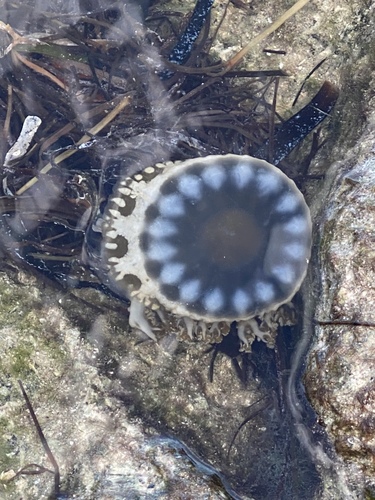

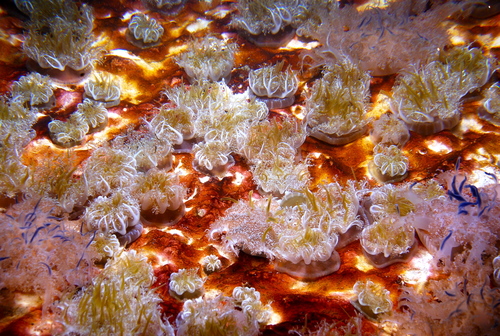


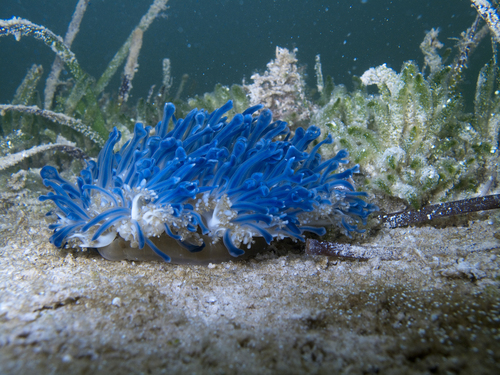
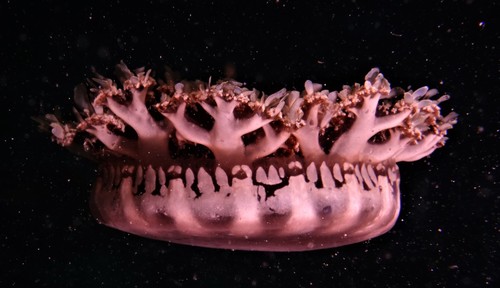
9 photos from iNaturalist (Creative Commons) · credits & licences
- 1. © Dani Barchana · CC BY-NC 4.0
- 2. © prilfish · CC BY 4.0
- 3. © charm · CC BY-NC 4.0
- 4. © 104623964081378888743 · CC BY-NC 4.0
- 5. © Adam Fagen · CC BY-NC-SA 4.0
- 6. © James Walsh · CC BY-NC 4.0
- 7. © Aaron Gustafson · CC BY-SA 4.0
- 8. © Humberto Bahena Basave · CC BY-NC 4.0
- 9. © Ryan Yue Wah Chan · CC BY-NC 4.0
what is it?
Cassiopea andromeda (Upside-down jellyfish) is a type of jellyfish that usually lives in intertidal sand or mud flats, shallow lagoons, and around mangroves. This jellyfish, many times mistaken for a sea anemone, usually has its mouth upward on the bottom. Its bell, which is yellow-brown with streaks and spots that are white or pale, vibrates to make the water flow through its arms for respiration and the obtaining of food.
base stats
Bars compare against all animals on log scales: up to 300,000 Dutch and 600,000 worldwide sightings (the most-seen species), 150 t (blue whale), 30 m and 400 years (Greenland shark).
fun facts
- No confirmed wild sightings in the Netherlands on iNaturalist: you'd have to travel for this one.
- 3,087 observations worldwide on iNaturalist.
- Scientifically named by Peter Forsskål in 1775 (251 years ago).
fact sheet
- English
- Mangrove Upsidedown Jelly
- scientific name
- Cassiopea andromeda
- class
- Scyphozoa
- order
- Rhizostomeae
- family
- Cassiopeidae
- sightings in NL
- 0
- sightings in Europe
- 13
- sightings worldwide
- 3,087
- GBIF records in NL
- 0
- weight
- —
- length
- —
- lifespan
- —
- named
- 1775 by Peter Forsskål
Sources: iNaturalist taxon 326834, Wikidata Q1048402, GBIF 2264603, Wikipedia (EN), Wikipedia (NL). Intro text from Wikipedia (CC BY-SA 4.0).Updated 2026-10-24.