
#0777 · 🐦 birds
European Bee-eater
🇳🇱 Bijeneter ·Merops apiaster





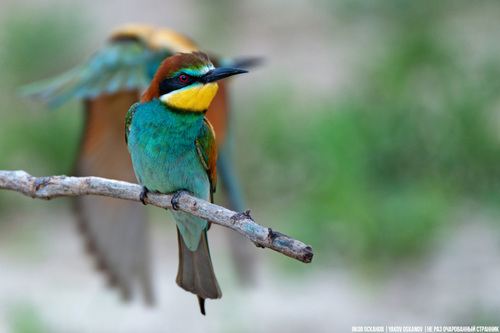

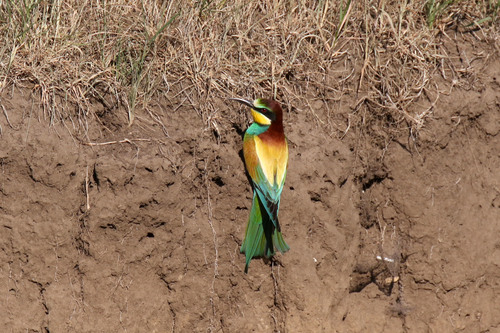
8 photos from iNaturalist (Creative Commons) · credits & licences
what is it?
The European bee-eater ( Merops apiaster ) is a near passerine bird in the bee-eater family Meropidae. The genus name Merops is Ancient Greek for "bee-eater", and apiaster is Latin, also meaning "bee-eater", from apis , "bee". It breeds in southern Europe and in parts of north Africa and western Asia. It is strongly migratory, wintering in tropical Africa. This species occurs as a spring overshoot north of its range, with occasional breeding in northwest Europe.
base stats
Bars compare against all animals on log scales: up to 300,000 Dutch and 600,000 worldwide sightings (the most-seen species), 150 t (blue whale), 30 m and 400 years (Greenland shark).
fun facts
- Spotted 35 times in the Netherlands on iNaturalist.
- 38,119 observations worldwide on iNaturalist.
- Weighs only about 7 g.
- Scientifically named in 1758 (268 years ago).
fact sheet
- English
- European Bee-eater
- Nederlands
- Bijeneter
- scientific name
- Merops apiaster
- class
- Aves
- order
- Coraciiformes
- family
- Meropidae
- IUCN Red List
- LC · least concern
- sightings in NL
- 35
- sightings in Europe
- 27,397
- sightings worldwide
- 38,119
- GBIF records in NL
- 9,367
- weight
- 6.5 g
- length
- —
- lifespan
- —
- named
- 1758
IUCN in Dutch: niet bedreigd. Blank means the sources don't say.
relatives· Meropidae

Sources: iNaturalist taxon 2191, Wikidata Q170718, GBIF 2475443, Wikipedia (EN), Wikipedia (NL). Intro text from Wikipedia (CC BY-SA 4.0).Updated 2026-10-24.